
Industrial door curtains: the types and how to match them to the opening
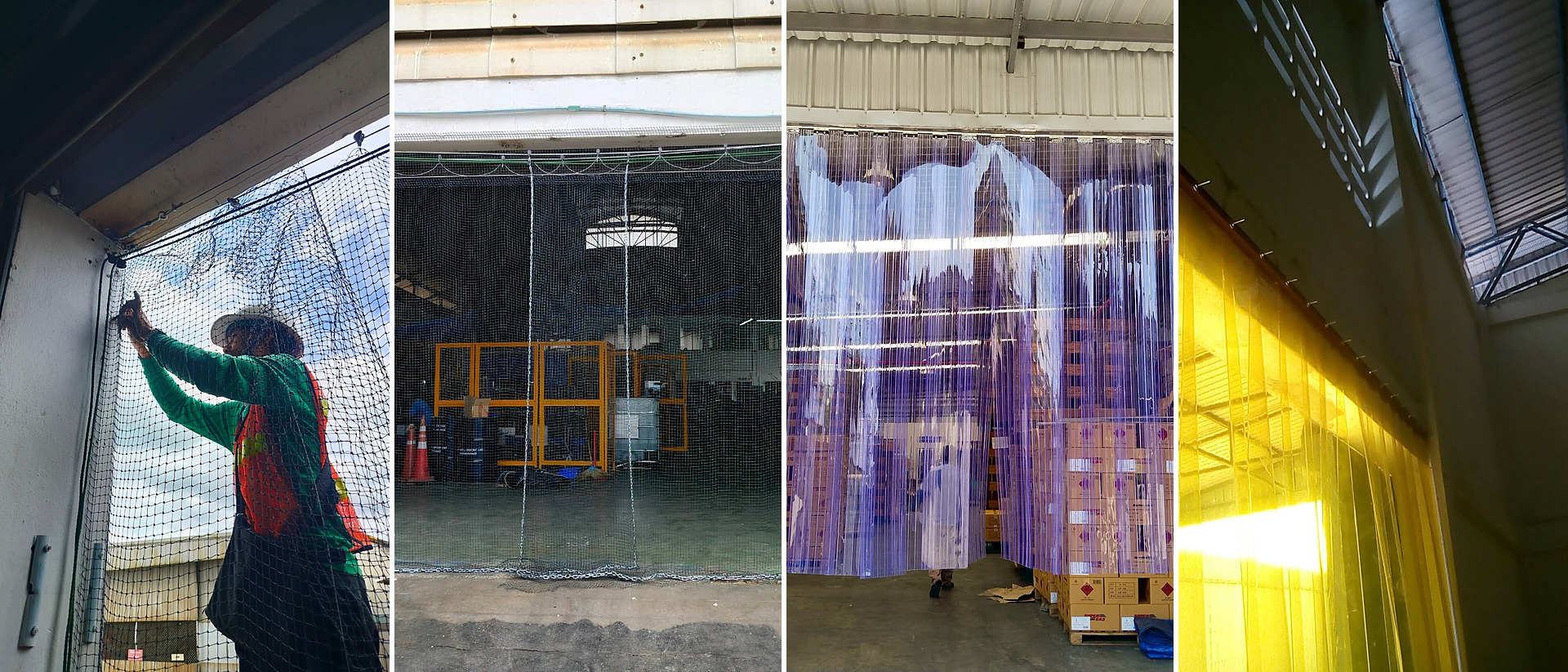
We install four types: rope, mesh, PVC strip and cold-room curtains. What decides which one is what the opening is used for. A loading bay with frequent vehicle traffic takes a different material and track from a pedestrian walkway.
A factory opening is a contradiction in itself: it has to stay open so goods can move, while still keeping out birds, insects, dust and heat. Door curtains are how that contradiction is resolved.
The four types we install
Mesh curtains
For openings that need to exclude birds and insects while still ventilating. Forklifts drive straight through without opening anything. They suit loading bays and warehouse entrances.
The mesh curtains we use are imported from the USA and Europe, up to 15 metres wide, so a large opening is covered without joins.
PVC strip curtains
For holding back dust and controlling temperature between zones. They are see-through, so they suit points where people and vehicles need to see the other side before passing.
Cold-room curtains
Made not to stiffen at low temperature. Ordinary PVC strip used in a cold room goes hard and cracks along the folds before long.
Rope curtains
Made in Thailand, and the economical option for ordinary walkways that do not need dust exclusion or temperature control.
How to choose
The first question to answer is what the opening is for.
A loading bay with dozens of vehicle movements a day needs a material that takes impact and a track that handles repeated swing. A pedestrian walkway has far lighter requirements.
The second question is what you are keeping out. Birds alone: mesh. Dust and temperature: PVC strip. A cold room needs a curtain made specifically for cold.
The third question is whether you need to see through. Anywhere vehicles and people share the opening should take a material that shows the other side, to reduce the risk of collision.
Mesh curtains and bird control
The loading bay is the main way birds get into most warehouses and plants, because it stands open all day and is usually high enough for birds to fly straight in.
Plenty of plants invest in netting the roof openings completely, and then find birds still getting in — because the loading bay in front of them was overlooked.
A mesh curtain solves that without affecting operations. Vehicles still pass, air still moves, but birds cannot get in.
The track, which usually gets overlooked
People choose the curtain by its material and forget the track, even though the track is what decides how long the curtain lasts.
An opening with frequent vehicle traffic needs a stronger track and a suspension system that lets the curtain swing back into place on its own. With a track that is too light, the curtain comes off it within a few months and the opening is wide open again.
Looking after it afterwards
Mesh and PVC strip curtains need checking once a year. The points to look at are the suspension and any impact tears. Repairing a small tear early is far cheaper than replacing the whole set.
Cold-room curtains should be checked more often, because the temperature cycling fatigues the material faster.
How it is priced
It is priced on the size of the opening, the curtain type, the number of openings and the track arrangement required.
An opening with frequent vehicle traffic takes a different material and track from a pedestrian walkway, so the rate per square metre is not the same even for openings of the same size.
We survey the site free of charge within one working day and measure the actual opening before quoting — dimensions taken from construction drawings rarely match the site after some years of use.
Measuring an opening correctly
Dimensions from construction drawings rarely match the site after years of use, because of extensions, repairs and changes to floor level.
What has to be measured on site is the clear width of the opening, the height from floor to the point where a track can be hung, and the space left above the opening for the track itself.
The dimension people get wrong is the height, because they measure floor to lintel and forget the allowance for the track and for the curtain to touch the floor exactly. Order it short and a gap is left underneath for birds and insects; order it long and the curtain drags and wears out quickly.
The other issue is uneven floors. Many loading bays are graded for drainage, so the height differs from one side to the other. Both sides have to be measured and the curtain cut to the real levels.
Can a curtain be used with a roller shutter?
Yes, and plenty of plants do exactly that.
The roller shutter closes at the end of the day for security; the curtain does the work during the day when the shutter is up. That is when birds and insects come in.
What has to be checked is the track position: the curtain track must not foul the shutter's barrel housing or its path as it rolls. We measure that clearance at the survey before proposing a layout.
Signs a curtain is due for replacement
Curtains do not fail all at once. They go strip by strip, starting where the impacts are heaviest.
What to look for: more than two or three strips torn or off the track; the bottom edge curling so it no longer touches the floor; or, with PVC strip, the material clouding over so you can no longer see through.
Replacing only the damaged strips is far cheaper than replacing the set. Checked once a year and repaired strip by strip, one curtain lasts considerably longer than one left until the whole set has to come down.
Let us survey your site before you decide
Request a quotation