
Cleaning factory roof structures: why in-house teams cannot do it
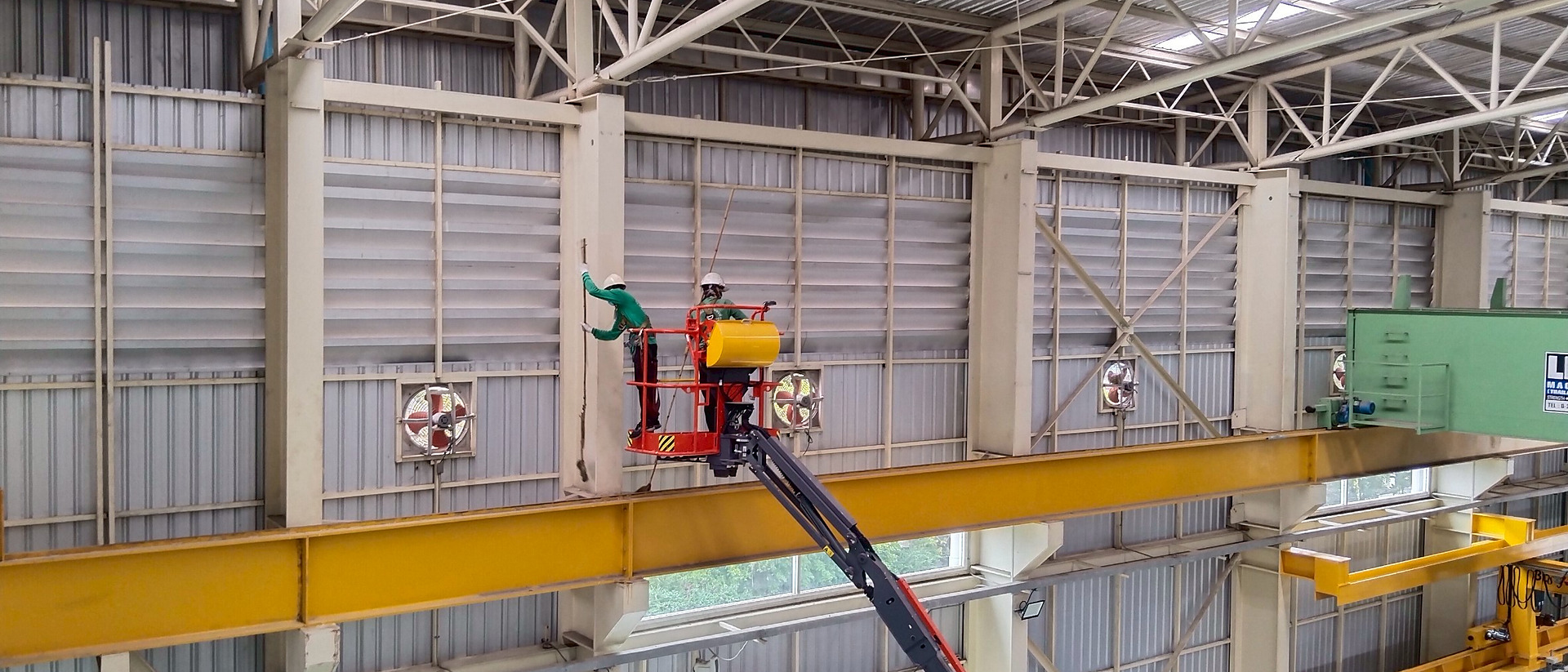
Dust, residue and droppings on roof structures and high steelwork fall onto the production line, but it is an area with no walkway, sitting above machinery that cannot be stopped. That needs access equipment and a plan made in advance. The company does not take rope-access window cleaning on high-rise façades.
In a plant that has been running production for years, the roof structure is the one area almost nobody goes up to look at — until something falls onto the conveyor.
What accumulates up there
Dust from the process that rises and settles on steelwork and roof sheet. Cobwebs building up in corners and at joints. Oil film in plants with oil mist. And droppings wherever birds have been nesting.
All of it sits directly above the production area. Past a certain point it comes down on its own, or comes down when machinery vibrates.
In a food plant this is a finding a standards auditor looks for directly, and one that cannot be argued with, because it is visible to the naked eye.
Why an in-house cleaning team cannot do it
The answer is not only height.
First, reaching points with no walkway. Most factory roof structures were never designed for anyone to stand on. Walking on purlins or on roof sheet risks going through it, so the work needs load-spreading equipment, or access from below with a cherry picker.
Second, working above machinery that cannot be stopped. The sequence has to be planned — which zone when, and how the area below is screened.
Third, controlling what comes down. Sweep cobwebs down without screening and the problem moves straight from the roof onto the production line. Containment and collection have to be planned before any sweeping starts.
What we take on
We clean factory roof structures, high walls and internal steelwork; sweep cobwebs from factory roofs and steel framing; clean production lines and the areas above machinery; and remove droppings and accumulated residue from elevated structures, with disinfection in the same visit.
What we do not take is rope-access window cleaning on high-rise façades. We say so plainly because we are asked often, and it is better than taking work outside what we do well.
Doing it together with bird control costs less
A plant with a bird problem should have the roof structure cleaned and the exclusion system installed in the same visit.
The plain reason is access cost. Erecting scaffold or hiring a cherry picker is a large share of the price of any work at height, and two separate jobs means paying for access twice.
The other reason is that cleaning alone, without an exclusion system, lets the droppings build back to the same level within a few months.
How often it should be done
Mostly it depends on the type of production. A plant with heavy process dust needs it more often than an assembly operation.
A better guide than counting months is looking at the actual condition. Cobwebs hanging from the structure, or residue visible on the roof sheet from floor level, means it is due.
Food plants should set the interval in the maintenance plan and keep the records, because that is the documentation used at audit.
How it is priced
The main factors are the total area, the height, and the access method — scaffold, cherry picker or crane. After that come how much residue has built up, and any restriction on working hours, such as having to work during a line shutdown or at night.
Ten years of accumulation and an annual clean take very different amounts of time, even over the same area.
We survey the site free of charge within one working day, and we serve buildings and plants nationwide.
Why the area below has to be screened
What surprises people is that roof cleaning takes about as long to prepare the area below as it does to do the work above.
The reason is that what comes down has to go somewhere. Without screening and collection, years of accumulated dust and cobwebs land on machinery, conveyors and the raw material below — so a roof problem has been solved by creating a new one on the production line.
In a food plant it is worse than that, because it can mean scrapping raw material or washing down the whole line again.
Our method therefore always starts with covering and screening, and only then goes up.
What to have ready before the crew arrives
- the schedule of when the line can be stopped, or when machinery is not running
- the area beneath the work cleared, with raw material and finished goods moved out
- usable power and water points
- whatever safety documentation the plant requires of contractors
If the plant has a roof plan, or knows where the roof sheet has leaked or been repaired, that is very useful to pass on — those are the points the crew has to treat carefully for load.
Contracting it out versus buying equipment for your own team
Plants that need this every year often ask whether buying the equipment and having the maintenance team do it works out cheaper.
It depends what equipment is actually needed. If the work is reachable with ordinary scaffold and nothing has to be done above running machinery, doing it in-house is reasonable.
But if it needs a cherry picker or a crane, the hire cost per occasion is usually more than the labour difference — and there is still work-at-height training and insurance to arrange.
What we suggest is splitting the work by height. Anything reachable from the floor or a short ladder is better done in-house; roof structure work is easier to manage as a contracted cycle.
Let us survey your site before you decide
Request a quotation